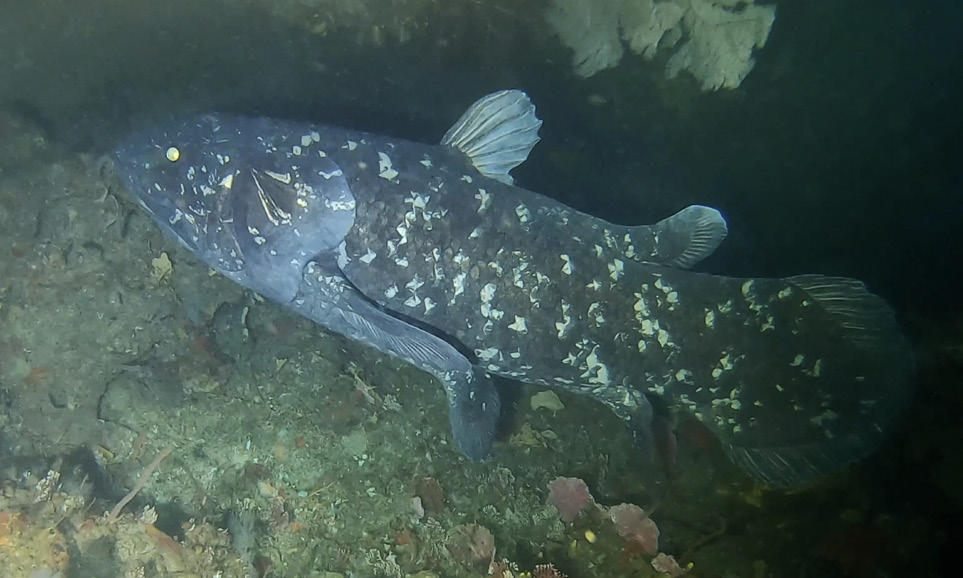
Genome of the coelacanth sequenced
On Apr. 17, 2013, an international team of researchers has decoded the genome of a creature whose evolutionary history is both enigmatic and illuminating: the African coelacanth. A sea-cave dwelling, 5-foot-long fish with limblike fins, the coelacanth was once thought to be extinct. A living coelacanth was discovered off the African coast in 1938, and since then, questions about these ancient-looking fish have loomed large.
Coelacanths today closely resemble the fossilized skeletons of their ancestors of more than 300 million years ago. Their genome confirms what many researchers had long suspected: Genes in coelacanths are evolving more slowly than in other organisms.
In addition to sequencing the full genome — nearly 3 billion “letters” of DNA — from the coelacanth, the researchers also looked at RNA content from the coelacanth (both the African and Indonesian species) and from the lungfish. This information allowed them to compare genes in use in the brain, kidneys, liver, spleen, and gut of lungfish with gene sets from coelacanths and 20 other vertebrate species. Their results suggested that tetrapods are more closely related to lungfish than to the coelacanth.
However, the coelacanth is still a critical organism to study to understand what is often called the water-to-land transition. The lungfish may be more closely related to land animals, but its genome remains inscrutable: At 100 billion letters in length, the lungfish genome is simply too unwieldy for scientists to sequence, assemble, and analyze. The coelacanth’s more modest genome (comparable in length to our own) is yielding valuable clues about the genetic changes that may have allowed tetrapods to flourish on land.
By looking at what genes were lost when vertebrates came on land as well as what regulatory elements — parts of the genome that govern where, when, and to what degree genes are active — were gained, the researchers made several unusual discoveries regarding sense of smell, immunity, evolutionary development, and urea cycle.
Tags:
Source: Harvard University
Credit: