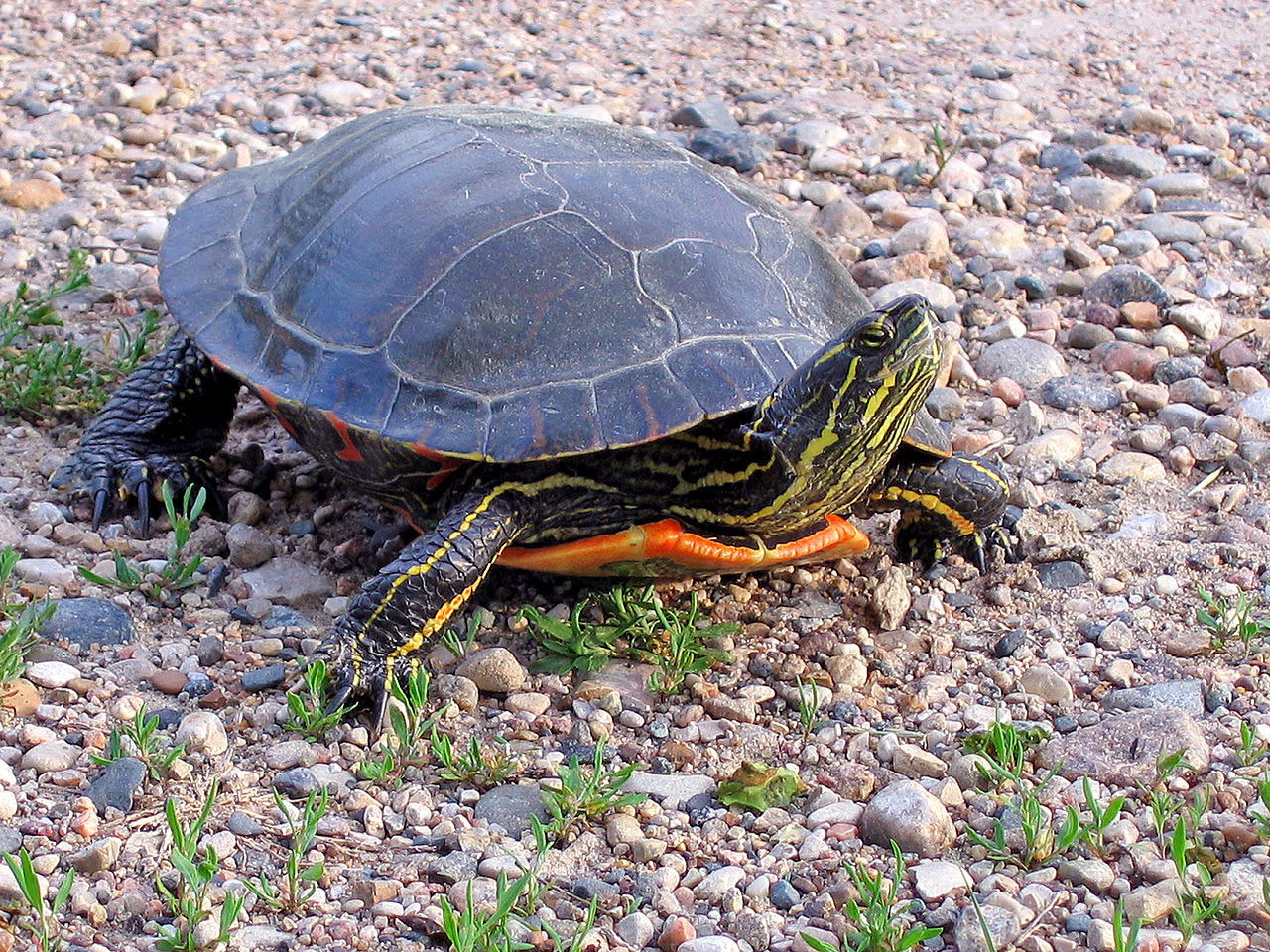
Genome of the western painted turtle sequenced
On Apr. 3, 2013, scientists announced they had decoded the genome of the western painted turtle, one of the most abundant turtles on Earth, a move that may unravel clues about the creature’s ability to survive without oxygen during long winters spent hibernating in ice-covered ponds. The research team included scientists at Washington University School of Medicine in St. Louis, the University of California at Los Angeles, St. Louis University and other institutions The multi-institutional team of researchers published their work in the journal Genome Biology.
The new data confirm that the turtles’ pace of evolution parallels their speed on the ground. In other words, it’s exceedingly slow, about one-third of the rate of human evolution and one-fifth the rate of the fastest evolving python. In fact, turtles have evolved a distinctive body design that has changed little over the past 210 million years, the authors note. Unlike other reptiles, turtles sport a sharp beak instead of teeth and live encased in a hard shell, a convenient home in which to hide when danger lurks.
The western painted turtle lives in freshwater ponds and streams and is the most widespread turtle in North America. It holds the distinction of being the first turtle and only the second reptile to have its genome sequenced. Comparing the turtle’s DNA to that of other animals, the scientists show that turtles are more closely related to birds than to lizards and snakes.
Like other turtles, painted turtles are slow to age and are known for their long life spans. They become sexually mature at about 5 years of age and can live for 40 or more years in the wild. While impressive, some other turtle species don’t reach sexual maturity until their 40s and can live for well over a century. The researchers also identified common patterns of gene loss in the turtle associated with longevity, sex determination and a lack of teeth, findings that warrant further investigation.
One aspect of turtle evolution that is progressing rapidly is their threat of extinction. As many as half the 330 turtle species worldwide are considered threatened, making them the most endangered major group of vertebrates on a global scale. Their demise is due, in part, to human consumption, encouraged by unsubstantiated but persistent claims that eating turtles can increase life expectancy and cure cancer. Habitat loss and modification are also important, but it is turtles’ popularity on restaurant menus and dinner tables, particularly in Asia, that is the biggest reason for their global decline, the researchers say.
Tags:
Source: Washington University School of Medicine
Credit: Photo: Painted turtle basking in the sun. Courtesy: Gary Eslinger, U.S. Fish and Wildlife Service.